
Grant Parish Criminal Docket Searches
For covered cases, begin at the eClerks Criminal Search. This is a statewide Louisiana tool. It is not a complete Grant Parish database of every court file. Type a last name first. Then add a first name, a filing-date range, and the Grant Parish filter where the fields allow. A case number plus a date filed beats a name match alone when you contact the clerk.
Need a current district-court setting? Check the 35th JDC’s official docket publication too. Older, incomplete, or confusing results call for the Grant Parish Clerk of Court. Ask for the exact document by name. The Clerk routes requests for minute entries, indictments, motions, orders, subpoenas, evidence, judgments, and certified copies. The portal and the Clerk do different jobs, and a Grant Parish criminal docket search usually needs both.
- Identify whether the notice names the 35th Judicial District Court, a town court, or another court.
- Use the eClerks criminal search with name, date, and parish filters for a qualifying case.
- Compare the case number, date filed, and charge before treating a result as the right case.
- Use the case number and event date when asking the Clerk for a particular record.
Grant Parish Criminal Search Fields
Filters drive the statewide criminal screen; full-file access is not promised. A narrow query cuts down same-name noise in a Grant Parish docket search. The official guide lists the fields below, and the case detail view can add dated minute text along with clerk contact information for the court records you want.
| Field | Use | Search note |
|---|---|---|
| Last Name | Primary party filter | Start with spelling variants when needed. |
| First Name | Refines a common surname | Use with, not instead of, a date range. |
| From / To Date | Narrows filing period | A range does not prove statewide coverage. |
| Parish | Limits results to Grant Parish | Use the parish checkbox for local routing. |
| Case / minute details | Confirms a returned case | Check date filed, charge, and dated entry text. |
The official criminal search tool and the Grant Parish criminal docket reference image illustrate these field options.
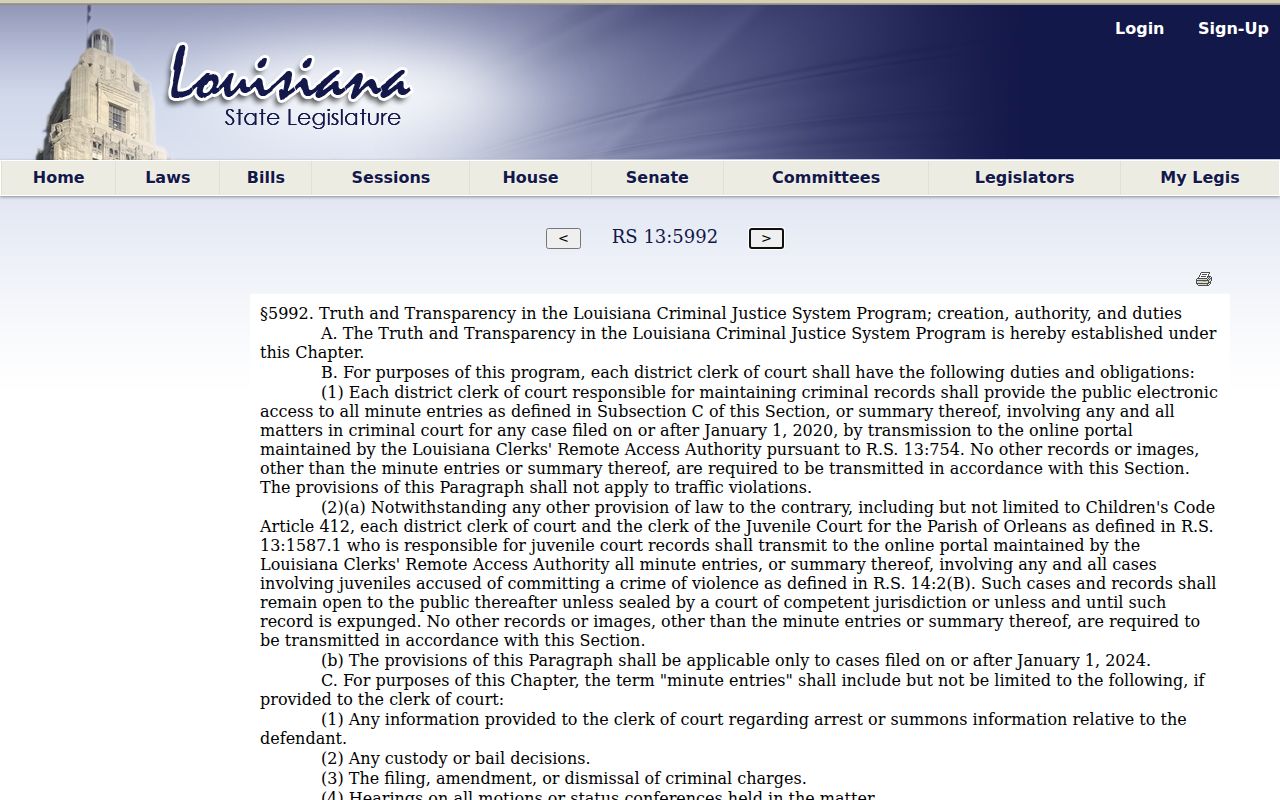
The statute-facing source confirms the point. The search targets qualifying criminal minute entries, not an all-purpose archive of Grant Parish court records.
Criminal Dockets: What They Show
A criminal docket is procedural, nothing more. The eClerks guide describes results by case number, filing date, charges, arrest date, parish, and selected distinguishing fields. The detail view adds a charge, an offense code, and a minute-details table. That is the shape of the entry. The Clerk’s criminal work runs wider. It covers filed motions and orders, subpoenas, evidence, and bond-forfeiture notices in Grant Parish.
| Case | The court’s number for the matter, used when requesting a copy. |
|---|---|
| Date filed | The filing date shown with a returned criminal case. |
| Charge | A listed charge and, where supplied, statute or offense code. |
| Minute details | Dated text such as a setting, filing, adjudication, plea, or sentencing event. |
| Clerk record | The particular filing, minute, or certified document requested from the custodian. |
A minute entry is an outline of what happened in court. It is not a transcript. It is not a police report. It is not the prosecutor’s file or proof that every exhibit sits online. If you need a verbatim record, ask for a transcript by name. The Clerk can tell you whether one exists and what process applies.
Grant Parish Criminal Minute Limits
Louisiana R.S. 13:5992 governs online availability of criminal minute entries in qualifying cases filed on or after January 1, 2020. Traffic matters are expressly excluded. Covered material can include arrest or summons information, custody or bail, charging, motions, hearings, trial or adjudication, guilt, sentencing, and the people involved in the proceeding.
The scope has edges, though. A pre-2020 case, a traffic ticket, a municipal case, a juvenile matter, a sealed or restricted record, or a refresh problem can each return nothing. Grant Parish court records may still exist. A missing result is never a finding otherwise. Confirm the court, then ask the Clerk for the correct path.
Criminal Case Stages on the Docket
Cases move at different speeds, yet a docket tends to record the same major steps. Formal charging opens the district-court file. Arraignment marks the first plea-stage setting. Pretrial settings capture motions, counsel activity, and status work. Later comes a plea or trial entry, then disposition and sentencing when those events occur on the Grant Parish criminal docket.
Docket flow: Filing → Arraignment → Pretrial → Plea or Trial → Disposition → Sentencing.
Use the setting date to locate the event. When docket text runs too thin, request the matching minute or order from the court. Staff can give procedural information. They can help route a request. But they cannot advise on the substance of a pending case.
Grant Parish Criminal Clerk Records
The Grant Parish Clerk’s Criminal Department describes a working stream of records: formal charges from the district attorney, criminal minute entries, evidence, subpoenas, file-stamped motions and orders, and bond-forfeiture judgment notices. This is the route. Use it when an online hit names the case but skips the filing you need.
Bring the case number, the full party name, an approximate date, and the exact record sought. Asking for “the whole file” works poorly. A dated minute entry works far better. So does a bill of information, an indictment, a specific motion, an order, or a judgment. The Clerk explains copy and certification options. It cannot decide legal meaning, only hand over Grant Parish court records.
The Criminal Department’s official description appears in this Grant Parish criminal docket image.
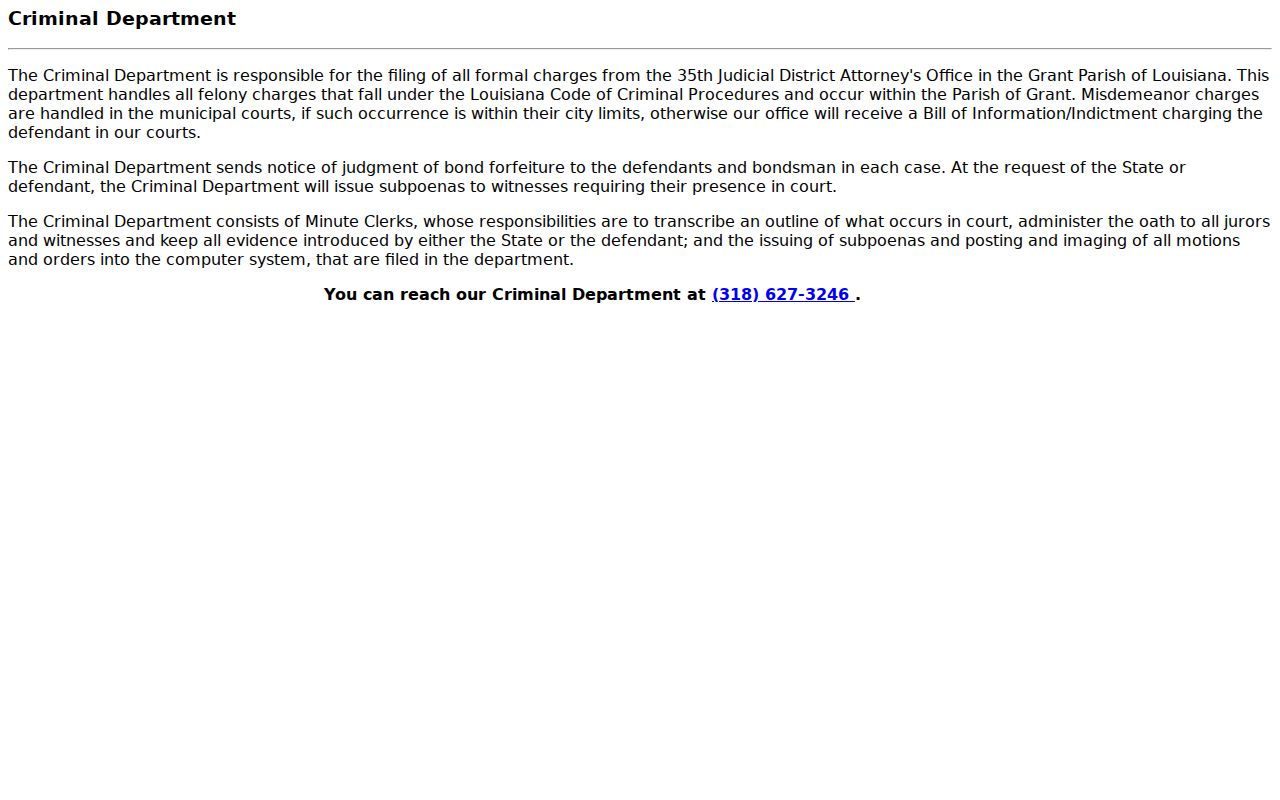
That official description supports one practical habit. Ask for Grant Parish criminal records by document type instead of assuming every item is a searchable docket entry.
Grant Parish Criminal Docket Courts
Felony prosecutions in Grant Parish land in the 35th Judicial District Court. Its Criminal Department takes formal charges filed under the Louisiana Code of Criminal Procedure. Misdemeanors work differently. When the alleged offense happened outside city limits, the Clerk of Court may receive a Bill of Information or Indictment. The case stays on the district-court docket.
Inside town limits, municipal courts own most misdemeanor and ordinance cases. A citation or notice may name a town court. It belongs with that court's own clerk or Mayor's Court contact. A municipality may sit in Grant Parish. That does not put every one of its misdemeanors on the 35th JDC criminal docket. Traffic tickets follow their own filing and payment routes too.
The official District 35 public-defense office page details the defense counsel. That counsel serves this Grant Parish criminal docket court.
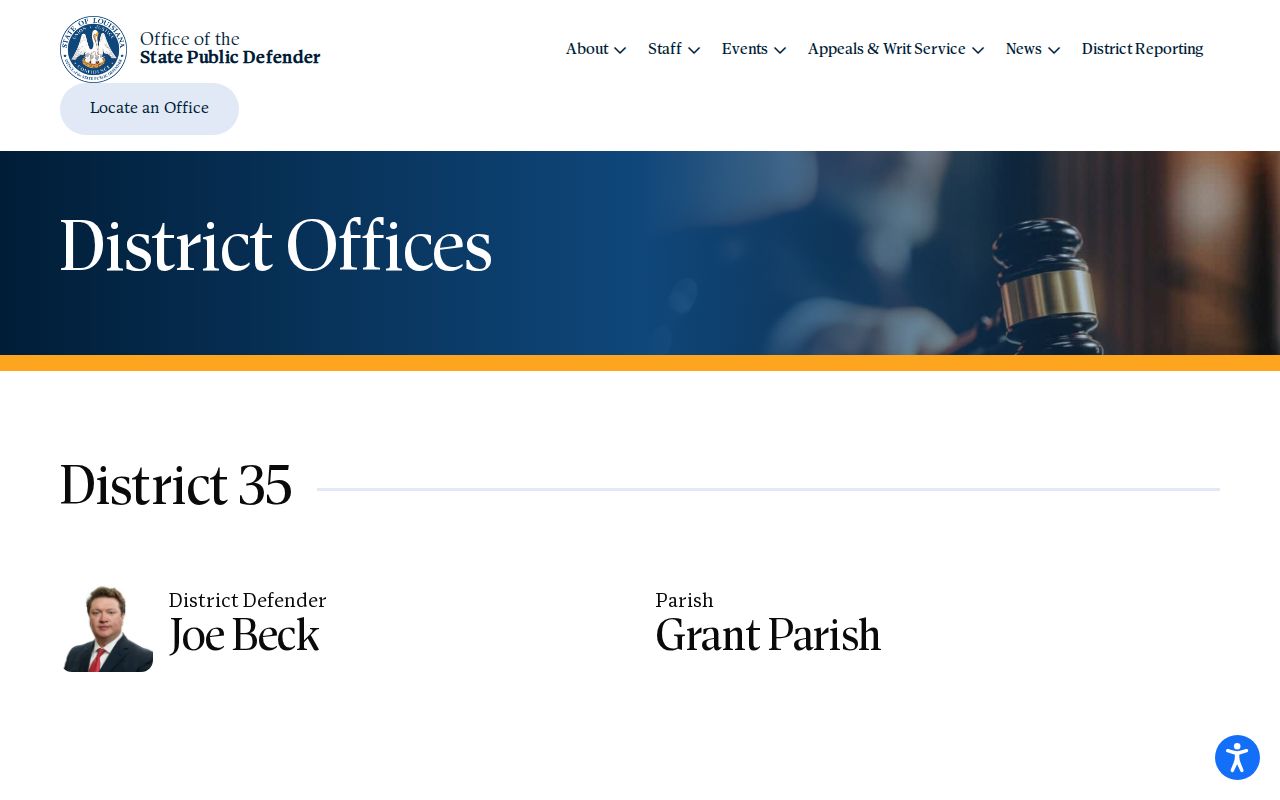
It adds local criminal-court context. A public docket entry is not a claim about any person or case outcome.
Grant Parish Criminal Result Routing
Treat an eClerks result as a pointer, not the whole file. The case number and date filed guide the request. That request may be a minute detail, a calendar entry, or a certified copy from the Clerk. Need a future court date? The official 35th JDC docket PDF is often the better source. A municipal notice points to the court printed on it. Appeals run separately through the Louisiana Third Circuit, which is its own docket layer.
Other eClerks channels stay separate from criminal search. The statewide civil, probate, land, and marriage indexes live on a different channel. Louisiana eFiling is a tool for attorneys, paralegals, and other filers. It is not a public case lookup. Keeping these systems apart stops a filing platform from being mistaken for a public criminal docket.
Why can a result look thin? The Grant Criminal Department's daily work also explains why a result can look thinner than what you asked for. The office receives formal charges from the district attorney and keeps the criminal process and minute-clerk outline. It files motions and orders. It handles subpoenas and retains evidence introduced in court. A charge or minute detail is often the start. It often marks the beginning of a targeted request. When your question concerns one motion, judgment, order, subpoena, evidence item, or certified minute, be specific. Give the Clerk the event date and document name. Do that instead of requesting the entire case.
Access Rules for Criminal Dockets
Access has real limits here. Juvenile filings and adoption records stay confidential under the Clerk's published policies. Court orders can shield sealed or protected material. So a missing search result may reflect a restriction. That restriction never licenses a workaround or disclosure of protected details. Ask the Clerk of Court directly what order, authorization, or identification a particular file requires.
Louisiana access rules:
Code of Civil Procedure Art. 251 identifies the district-court clerk as custodian and addresses copies and certifications.
R.S. 44:31 recognizes public inspection and copying subject to legal exceptions.
Children’s Code Art. 412 is a statutory anchor for confidential juvenile records.
Note: A charge is only an allegation, and a docket entry records procedure, not a conclusion about anyone.
Grant Parish Criminal Copy Fees
Copy costs in Grant Parish are modest but add up. The Clerk's criminal fee API lists criminal copies at $1 per page. Court minutes run $10 per date. Certification adds another $5. Expungement fees are murkier. The payment data says $250 to file. The expungement PDF says $200. Verify the current amount with the Clerk rather than picking either figure.
The official criminal-fee source lists the charges that apply to Grant Parish criminal docket copies.
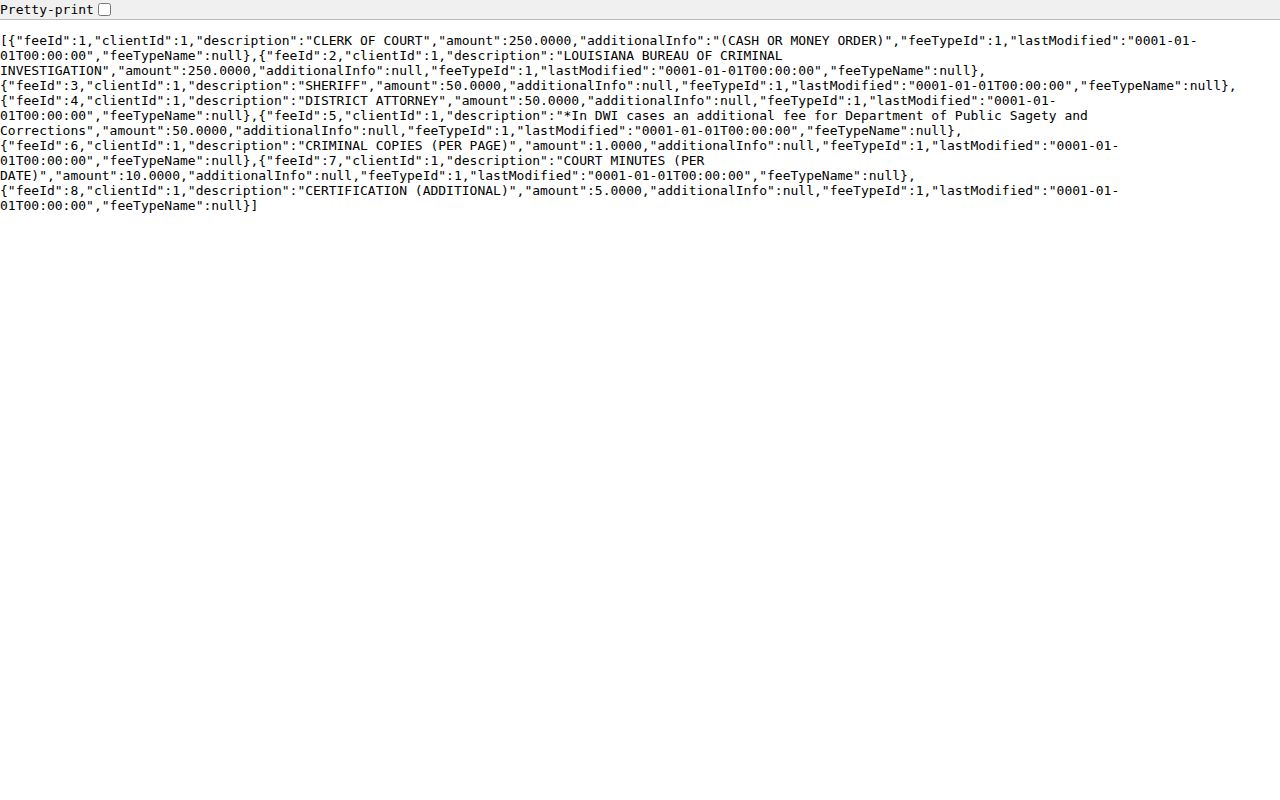
Fees and access are two different things. A record can be fully public while a copy, certified copy, or specialized filing still carries its own charge.